How Tutoring Transforms Maths Exam Preparation

The Challenge of Maths Exam Preparation
The weeks leading up to HSC maths exam represent a critical period for students and families. Despite months of classroom learning, many students find themselves struggling to translate their knowledge into effective exam performance. Late-night cramming sessions, mounting anxiety, and confusion over complex concepts become increasingly common as exam dates approach.
This disconnect between classroom learning and examination success isn't unusual. Many students discover that content knowledge alone—while essential—represents only one piece of the examination puzzle. The missing elements—strategic approach, time management, question interpretation, and performance under pressure—often determine the difference between bands in maths exam.
The frustration is very real for parents observing this process. A student who demonstrates clear understanding during lessons may still underperform in examinations when lacking the specific skills needed for this high-pressure environment.
Beyond Content: What Maths Exam Actually Test
Multiple dimensions, extending well beyond basic content recall, are used to evaluate students. Maths exam assess a student's ability to:
Recognise which mathematical concepts apply to specific problem types
Select appropriate solution strategies under time pressure
Communicate mathematical reasoning clearly and systematically
Navigate between different mathematical domains when problems cross topic boundaries
Maintain accuracy while working efficiently within strict time constraints
These examinations serve as critical gateways that influence university options and career pathways. For students aiming toward fields like engineering, medicine, data science, or finance, strong mathematical performance opens doors that might otherwise remain closed.
In competitive academic environments, these pressures intensify. Many students participate in accelerated programs or extension mathematics, raising expectations while potentially increasing examination stress.
When should my child start tutoring?
Strategic Approaches to Maths Exam Preparation
Understanding Exam Structure and Question Patterns
Effective maths exam preparation begins with demystifying the assessment itself. Mathematics examinations follow discernible patterns that, once recognised, make preparation more targeted and efficient.
Students benefit from understanding:
How marks are allocated across different question types
Which topics typically appear in multiple-choice versus extended response sections
How examiners signal question difficulty through specific language and presentation
Which mathematical skills are being assessed beyond the obvious content knowledge
Systematic analysis of these patterns helps students decode questions efficiently, recognising instantly whether they're facing a straightforward application problem or a multi-step challenge requiring deeper analysis.
Most exam questions follow recognisable templates with variations in context or numbers. Learning to identify these patterns transforms how students approach exams and build confidence when encountering the inevitable "surprise" question designed to test flexible thinking.
Time Management: The Hidden Examination Skill
Even mathematically talented students can underperform in exams when they haven't developed effective time management strategies. The pressure of the ticking clock fundamentally changes how students engage with mathematical problems.
Effective time management in maths exam involves:
Quick assessment of question difficulty and mark value
Strategic allocation of time based on potential point yield
Recognition of when to move on from challenging questions
Efficient verification methods that catch errors without consuming excessive time
The most common time management mistake isn't content-related—it's spending too long pursuing perfect solutions to early questions, then rushing through higher-value problems in the final minutes. Learning to budget time appropriately often produces immediate improvement in results.
Time management training involves structured practice under realistic conditions, developing an intuitive sense of pacing that allows students to navigate examinations with confidence rather than anxiety.
Question Interpretation and Strategic Response
Maths examinations often assess not just whether students can solve problems, but how efficiently they recognise the most appropriate solution pathway. This skill—identifying the mathematical principles behind a question and selecting optimal approaches—separates high-achieving students from their peers.
Key interpretation skills include:
Extracting essential information from complex word problems
Recognizing when multiple mathematical domains must be combined
Identifying shortcuts or elegant solutions that examiners reward
Structuring responses to demonstrate clear mathematical reasoning
Students frequently take unnecessarily complicated approaches to problems, using algebraic methods when geometric solutions would be more efficient, or applying calculus when simple substitution would suffice. Learning to select appropriate techniques is as important as knowing how to execute them.
This strategic thinking proves particularly valuable in the higher bands, where examination questions intentionally allow multiple solution pathways of varying efficiency. Students who can quickly identify optimal approaches gain significant advantages in both accuracy and time management.
How can I assess if tutoring is working?
The Personalised Nature of Effective Exam Preparation
Maths exam preparation cannot follow a one-size-fits-all approach. Each student brings unique strengths, challenges, and learning patterns that influence how they perform under pressure.
Personalised preparation addresses individual needs through:
Diagnostic assessment that identifies specific conceptual gaps
Analysis of error patterns in practice examinations
Customised practice focusing on areas of greatest potential improvement
Strategies tailored to individual learning styles and examination behaviours
Different students face different challenges: some struggle with specific content areas like calculus or probability; others have strong content knowledge but freeze under examination conditions; still others make careless errors when working quickly. Effective preparation addresses these specific challenges rather than assuming all students need the same approach.
This customised methodology proves particularly valuable in diverse educational landscapes, where students come from various schools with different teaching approaches and emphasis areas. Personalised tutoring bridges these gaps while building on existing strengths.
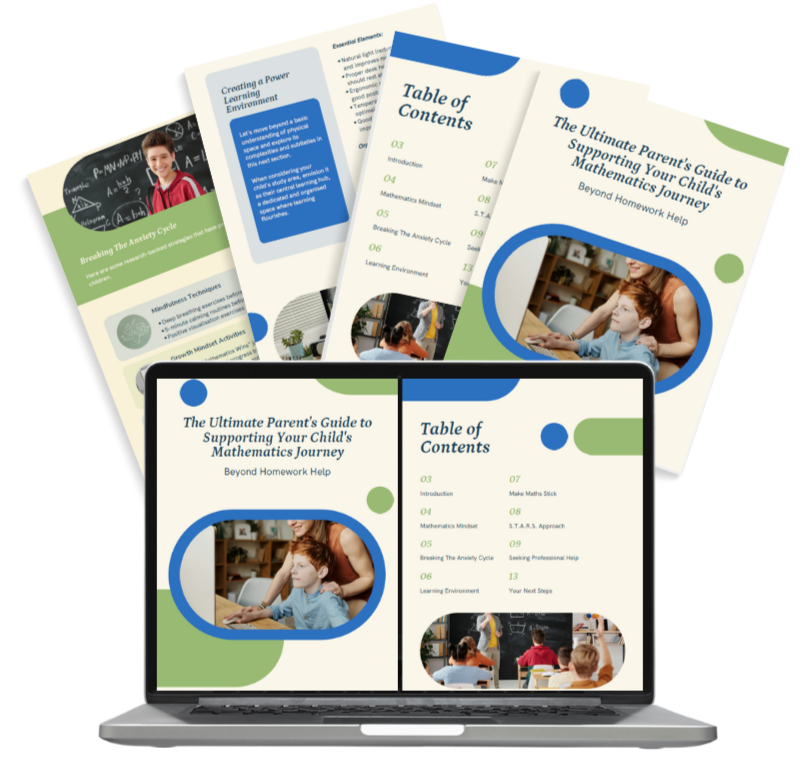
Get our FREE Maths Success Blueprint
Practical Examination Strategies for Maths Success
Structured Review Methodology
Effective exam preparation follows a systematic approach rather than random practice:
Comprehensive topic inventory - Create a detailed list of all curriculum areas, noting confidence levels for each
Prioritised practice schedule - Allocate preparation time proportionally, with greater focus on high-value or challenging topics
Deliberate practice - Target specific question types and solution strategies rather than general revision
Progressive simulation - Begin with untimed practice, then introduce time constraints that gradually approach examination conditions
This structured approach ensures that students address all curriculum areas while allocating appropriate time to challenging concepts. Rather than reviewing topics they already understand well, they focus attention where improvement will yield the greatest results.
Advanced Problem-Solving Frameworks
Maths exams often include questions designed to challenge even well-prepared students. Developing robust problem-solving frameworks provides tools for approaching these challenges systematically:
Breaking complex problems into manageable components
Applying multiple solution methods when standard approaches fail
Converting between different mathematical representations (algebraic, graphical, numerical)
Working backward from required answers when direct solutions aren't obvious
Learning to approach unfamiliar problems methodically rather than giving up when standard methods don't apply builds resilience. This quality proves particularly valuable in examinations where questions intentionally test flexible thinking.
These problem-solving frameworks provide confidence when facing challenging questions, reducing anxiety and allowing students to demonstrate their mathematical abilities even under pressure.
Error Prevention and Verification
Avoidable errors, not a lack of knowledge, are responsible for many lost marks in maths exams. Systematic verification strategies help students maximise their scores:
Dimensional analysis to verify that units match appropriately
Order-of-magnitude estimation to catch calculation errors
Substitution of solutions back into original equations
Cross-checking answers using alternative methods
Developing automatic verification habits transforms examination performance. Students learn to catch their own errors before submitting answers, often turning partial marks into full credit.
These verification techniques require minimal time when practiced regularly, providing significant benefits in accuracy without compromising examination pacing.
Building Mathematical Confidence Through Preparation
Perhaps the most valuable outcome of structured exams preparation is the confidence it develops. Students enter examinations, not hoping for familiar questions, but equipped to handle whatever challenges appear.
This confidence stems from:
Repeated success with challenging practice problems
Familiarity with the full range of potential question types
Proven strategies for managing time and pressure
Experience recovering from mistakes without losing focus
In competitive academic environments, this confidence often makes the critical difference between bands, particularly in distinguishing Band 5 from Band 6 performance in mathematics.
How does online maths tutoring work?
How Lee Mathematics Tuition Supports Exam Preparation
At Lee Mathematics Tuition in Hurstville, we provide comprehensive support for students preparing for maths exam through a structured, multi-faceted approach:
Customised Assessment and Planning
Our support begins with a thorough assessment to identify each student's unique strengths and areas for development:
Comprehensive skills assessment across all mathematics syllabus areas
Analysis of previous examination performance and error patterns
Identification of specific conceptual gaps requiring attention
Development of personalised preparation plans with clear timelines and milestones
This individualised approach ensures that tutoring addresses specific needs rather than following generic examination preparation formulas.
Targeted Content Reinforcement
While many students have covered the required content in school, gaps in understanding often emerge during exam preparation:
Topic-specific review sessions that clarify challenging concepts
Connections between related mathematical areas to strengthen conceptual understanding
Application of theoretical knowledge to examination-style problems
Alternative explanations and approaches when traditional methods haven't connected
Our experienced tutors efficiently address knowledge gaps, ensuring a solid foundation for exam success.
Examination Technique Development
Beyond content knowledge, we focus intensively on developing examination-specific skills:
Question analysis and interpretation strategies
Time management techniques customised to different examination formats
Structured approaches for multi-step problems
Effective communication of mathematical reasoning to maximise marks
Error detection and correction methodologies
We teach these exam techniques progressively, building confidence and skill through a series of increasing challenges.
Simulated Exam Experience
Realistic practice forms a cornerstone of our examination preparation approach:
Full-length practice examinations under timed conditions
Graduated difficulty levels that build stamina and confidence
Detailed performance analysis identifying patterns and improvement opportunities
Post-examination review focusing on both content knowledge and examination strategy
This systematic simulation helps students develop the mental endurance needed for sustained performance during actual examinations.
Approaching Exam Preparation: Next Steps
Effective exam preparation begins with an honest assessment. Consider:
Does understanding concepts in class translate to success in timed assessments?
Have practice examination results matched classroom performance?
Does examination anxiety significantly impact mathematical performance?
Are careless errors a persistent issue in assessments?
These challenges respond well to structured preparation approaches that address both content knowledge and examination technique. At Lee Mathematics Tuition, we offer personalised programs that bridge the gap between classroom learning and examination performance.
Our flexible scheduling includes both face-to-face sessions at our Hurstville location and online options that maintain our commitment to personalised support. Contact us to discuss how targeted exam preparation can help students demonstrate their true mathematical potential in upcoming assessments.
Book a FREE ASSESSMENT todayFAQs